
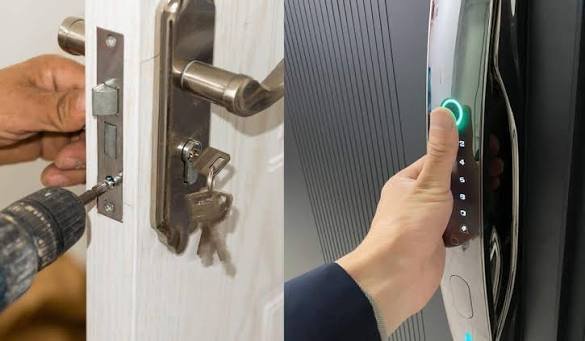
Standing outside your own front door at 11 PM, patting down every pocket looking for keys that are, of course, sitting on the kitchen counter — has this ever happened to you? That exact moment is usually what pushes people to start researching smart locks vs traditional locks, wondering if there’s a better way.
I switched to a smart lock on my own front door about a year ago, mostly out of curiosity more than necessity. My honest verdict, a year in: genuinely useful, but not the flawless upgrade some marketing makes it sound like. This comparison covers what actually matters — security, cost, reliability during power cuts (a very Indian concern), and day-to-day practicality — so you can decide which fits your household better in 2026.
The Core Difference Between Smart and Traditional Locks
Featured answer: Traditional locks use a physical key and mechanical pins to secure a door, while smart locks use electronic mechanisms — PIN codes, fingerprints, RFID cards, or app-based unlocking — often alongside a physical key backup. Smart locks add convenience and remote access; traditional locks offer simpler, more predictable mechanical security.
Traditional locks have been around, essentially unchanged in principle, for well over a century. Pin tumbler mechanisms, a key that fits precisely, nothing connected to power or an app. Reliable in the most basic sense — they just work, rain or shine, power cut or not.
Smart locks add a layer of convenience most people genuinely appreciate once they get used to it — no more digging for keys, ability to let someone in remotely, code-based access for domestic help or guests. But that convenience comes with new things that can go wrong.
Security Comparison: Which Is Actually Safer?
This is where opinions get genuinely divided, and I don’t think there’s a clean, universal answer.
- Traditional locks can be picked or bumped by someone with the right skill and tools, though this requires physical presence and some expertise
- Smart locks are vulnerable to different risks — hacking, signal jamming, or software vulnerabilities, though good ones have layered security to counter this
- Smart locks often log entry and exit, giving you a record traditional locks simply can’t provide
- A smart lock’s biggest weakness is dependency — battery failure, app bugs, or connectivity issues can lock you out at an inconvenient moment
I’d say a good quality smart lock is roughly as secure as a good traditional lock, just vulnerable to a different category of problems. A cheap smart lock, though, can genuinely be less secure than a decent traditional deadbolt — the market has a lot of low-quality options riding the “smart” trend.
Cost Comparison: Smart Locks vs Traditional Locks
Featured answer: Traditional locks in India typically cost ₹500-3,000 depending on quality and brand, while smart locks range from ₹6,000-20,000 including installation. Smart locks also often require occasional battery replacement and, in some models, an annual app subscription fee.
The price gap is significant, and worth being honest about upfront. A solid traditional deadbolt from a reputable Indian brand like Godrej or Yale costs a fraction of even a basic smart lock.
That said, smart locks eliminate certain hidden costs — no more paying a locksmith ₹300-500 every time someone loses a key, no need to replace locks after losing keys or after a domestic staff change.
Power Cuts and Reliability — A Genuinely Indian Concern
This is the question I get asked most often by friends considering a smart lock, and it’s a fair one given how common power fluctuations still are in parts of India.
- Most quality smart locks run on batteries, not mains power, so a power cut alone won’t lock you out
- Battery life typically ranges from 6-12 months depending on usage, with low-battery warnings well before it dies
- Nearly all reliable smart locks include a physical key backup for genuine emergencies
- Choose a smart lock with offline PIN access as backup, not one that’s entirely dependent on internet connectivity
Picture a small business owner in Jaipur who installed a smart lock on her shop’s back entrance, worried about staff losing keys constantly. A year in, her only real issue was a battery running low during a busy week — resolved in minutes with the backup key, no actual lockout ever happened.
[link to related guide on best home security systems for beginners here]
Which Makes More Sense for Your Household?
- Families with domestic help or frequent visitors — smart locks with individual PIN codes are genuinely convenient, avoiding physical key duplication
- Rented flats — traditional locks make more sense, since landlords often prefer simple, easily replaceable mechanisms
- Elderly residents living alone — traditional locks may be simpler and less intimidating, unless the smart lock has a very straightforward interface
- Tech-comfortable households wanting remote access — smart locks clearly win here, letting you grant access remotely to guests or deliveries
Installation and Maintenance Differences
Traditional locks are simple to install and need almost no ongoing maintenance beyond occasional lubrication. Smart locks need proper installation (often best done professionally to ensure correct fit and calibration) and occasional maintenance — battery changes, firmware updates on some models, and periodic testing of backup access methods.
[link to related guide on childproofing your home for safety here]
FAQ: Common Questions About Smart Locks vs Traditional Locks
Are smart locks safe to use during a power cut? Yes, most quality smart locks run on internal batteries rather than mains electricity, so a power cut alone won’t lock you out of your home.
Which is more secure, a smart lock or a traditional lock? Both can be equally secure when high quality — traditional locks resist different attack methods than smart locks, so the “safer” choice depends more on lock quality than the category itself.
Do smart locks work without internet or WiFi? Many smart locks offer offline access via PIN or fingerprint even without an internet connection, though remote app-based unlocking typically requires connectivity.
How long do smart lock batteries last? Typically 6-12 months depending on usage frequency, with most models giving low-battery warnings well in advance to avoid unexpected lockouts.
Is it worth installing a smart lock in a rented apartment? Usually not ideal, since landlords often prefer easily replaceable traditional locks, and reinstalling the original lock when moving out adds hassle.
Can smart locks be hacked? It’s technically possible with lower-quality models, though reputable smart locks use encryption and layered security that make hacking genuinely difficult for the average intruder.
[link to related guide on home security systems for beginners here]
Wrapping It Up
There’s no universal winner in the smart locks vs traditional locks debate — it really depends on your household, budget, and how much you value convenience over simplicity. Smart locks suit tech-comfortable families juggling multiple people needing access; traditional locks remain a solid, reliable choice for rentals or anyone who’d rather not think about batteries and firmware.
If you’re still unsure, consider starting with a smart lock on just one door — maybe the main entrance — before committing to replacing every lock in your home. That way you’ll know if it actually fits your routine before spending on the rest.
